


Table of content
What Is IQ? A Guide to IQ Meaning, Scores & Testing
What is IQ? Learn what it means, what IQ tests measure, how scores are calculated, common IQ ranges, and the limitations of intelligence testing.
Table of content
If you’re asking “what is IQ?”, this baseline can help forecast educational achievement, spot strengths and weaknesses, and identify areas where extra skill building or support may be needed.
Use that baseline to predict educational achievement, recognize strengths and weaknesses, and identify areas where additional skill development or support may be needed.
Definition of Intelligence: What Is IQ?
In their definition of intelligence, Resing and Drenth include the complete range of mental abilities involved in acquiring knowledge. This knowledge can then be applied appropriately to solve problems whose goals and structures are clearly specified.

One useful definition of IQ is Intelligence Quotient, a measure of a person's intelligence based on standardized tests. Understanding intelligence quotient meaning starts with seeing the score as a comparison of an individual's intellectual ability with that of others. Do not confuse it with total human worth or practical wisdom: it tracks performance on specific analytical tasks under controlled conditions.
What Does IQ Measure in Cognitive Tests
Full-Scale IQ
Full-Scale IQ brings together Verbal Comprehension, Visual Spatial, Fluid Reasoning, Working Memory, and Processing Speed indexes to produce one general score. These five areas provide a view of general intellectual functioning.
Strengths and weaknesses
Each area captures a different part of a person’s profile, so you can see strengths and weaknesses, plan school accommodations and learning support, and assess giftedness or intellectual disability. The result is a profile, not one ability.
Question types
IQ tests typically use Pattern detection, analogies, classification, spatial reasoning, and logical questions.
Adaptive behaviour
Adaptive behaviours are often considered alongside IQ when evaluating age-appropriate skills for independent living and everyday functioning. They can help evaluate several developmental and learning conditions.
These conditions include developmental delays, autism spectrum disorder, intellectual disability, learning disabilities, neuropsychological disorders, and sensory or physical impairments.
Fluid Reasoning
Fluid ReasoningIndex looks at how you spot relationships among visual objects and then use reasoning to find and apply rules. It covers inductive and quantitative reasoning, broad visual intelligence, simultaneous processing, and abstract thinking.
The abilities most closely tied to fluid reasoning include:
- Detecting the underlying conceptual relationship among visual objects
- Using reasoning to identify rules
- Applying rules
- Using inductive and quantitative reasoning
- Applying broad visual intelligence, simultaneous processing, and abstract thinking

Fluid reasoning gives you the engine for an unfamiliar trail, while general knowledge gives you the map and guidebook from earlier journeys.
Verbal Comprehension
Acquired word knowledge
Verbal ComprehensionIndex covers access to and use of acquired word knowledge. It also captures how you put meaningful concepts into words, think through verbal information, and express yourself.
Visual-Spatial Processing
Visual SpatialIndex focuses on reading visual details, understanding visual spatial relationships, and building geometric designs from a model. Its tasks draw on visual-spatial reasoning, part-whole integration and synthesis, and close attention to visual detail.
This area may also draw on hand-eye coordination and efficient handling of visual information.
Working Memory
Information in conscious awareness
Working Memory Index measures whether you can register, hold, and manipulate visual and auditory information in conscious awareness. Its tasks test attention, concentration, mental reasoning, and visual and auditory discrimination.
Working memory has a close link to learning and achievement. You can think of it as a small mental desk holding a few documents until you make room for the next step.
Processing Speed
Processing SpeedIndex covers how quickly and accurately you identify visual information, make decisions, and put those decisions into action. It connects with visual scanning, visual discrimination, short-term visual memory, visuomotor coordination, and concentration.
This skill may support reading development and your general ability to think quickly. It may also support functioning well in daily life.
How Is IQ Measured and Calculated
In practical terms, what is IQ? An IQ score tells you only how you performed on one particular intelligence test compared with people in your age group. Take that test, and its result becomes a measure of intelligence.
In recent years, psychologists have relied on the Wechsler scales as the most widely used measures of intelligence. Wechsler published his first scale in the 1930s, drawing on material from the Binet Alpha and Beta tests. Its age adjustment keeps scores comparable across the life span.
Classical Ratio Formula
IQ can be calculated with the following formula: IQ = (Mental Age / Chronological Age) × 100. Early ratio formulas produced extreme claims regarding the highest IQ in the world.
For a child with a Mental Age of 12 and a Chronological Age of 10, dividing 12 by 10 and multiplying by 100 gives 120, which is above average.
Modern Deviation IQ and Normal Distribution
The test distribution

Across the test population, the mean is 100 points, with a standard deviation of 15 points. 68 percent score between 85-115, while 95 percent fall between 70-130.
Relative comparison
Modern scoring places your result beside a large group of generational peers instead of tracking mental growth against calendar years; the average IQ score remains 100.
IQ Score Meaning and Percentile Ranges
An intelligence test produces an IQ score, and its average is 100. Scores above 100 indicate above-average performance, while scores below 100 indicate performance somewhat below average.
With an IQ score of 100, half the population scores higher than you and half scores lower; 100 indicates average intelligence.
A score of 120 means intelligence exceeding the population average.
At 130, your score exceeds 97,5 percent of your age group, while only 2,5 percent score higher, illustrating what is considered a high IQ.
The standard interpretation is:
- 100: Average intelligence
- 120: Above average
- Below 90: Below average
Limitations and Criticisms of IQ Testing
IQ tests mainly gauge selected abilities, such as verbal and mathematical reasoning. Real-life intelligence may also involve creativity, empathy, and practical skills that standard tests do not always capture. Despite those boundaries, a majority of educational and professional organizations still use IQ tests for first-round assessments.
Omission of Non-Cognitive Intelligences
IQ tests leave some abilities outside their scores, whereas other quotients examine human capability from each of several angles, with SQ including adaptability:
- EQ (Emotional Quotient): Evaluates emotional intelligence and self-management.
- SQ (Social Quotient): Assesses social skills and adaptability.
Every quotient highlights a different aspect of human ability.
Cultural and Linguistic Bias
Limited familiarity with language or context used in the test may influence performance.

Testing Anxiety and Physical Conditions
Testing anxiety, physical conditions, or unfamiliarity can shift results, showing performance in that moment while not reflecting your full ability.
Diagnostic Unreliability of Informal Online Tests
Online IQ tests are not considered medically reliable for diagnosing intellectual disabilities.
Casual online tests can provide entertaining mental exercises, but without standard clinical controls, they cannot serve as legitimate measures of cognitive function. Professional assessments completed by certified psychologists should be used to diagnose conditions and plan appropriate education.
Basic tests allow a ±5.6 IQ margin of error; full tests allow a ±3.7 IQ margin of error. You can take a free IQ test.
Practical Applications of IQ Testing
Practical use of IQ tests includes selecting applicants and identifying children who may need special support, while recognizing that intelligence or ability requires more than one measure.
Interpret IQ results alongside other methods, not in isolation.
The benefits of Intelligence Quotient tests include these uses:
- Highlighting talents that students might not know they have
- Identifying students with special learning needs
- Providing clear comparison for academic or professional needs
- Helping parents and teachers understand cognitive strengths
- Enabling teachers to adapt their teaching to individual needs
- Guiding students in selecting the right academic or career path

Schools and organizations can use IQ tests to gauge how well a person may learn new information and function in social or economic settings.
Educational Identification
Use IQ tests to standardize educational assessments and help ensure children showing exceptional abilities and those with special needs receive required attention, including children in need of special support.
Occupational Assessment
Organizations may use IQ tests to make informed decisions when hiring or placing employees in specific roles, while professionals may use them when selecting applicants.
Major Standardized IQ Tests
Famous standardized tests
Covering two famous standardized tests, this section names the Stanford-Binet Intelligence Scale and Wechsler Adult Intelligence Scale.
Common types of IQ tests
The main IQ test types include:
- Stanford-Binet Intelligence Scale
- Wechsler Intelligence Scales (for children and adults)
- Universal Nonverbal Intelligence Test
- Peabody Individual Achievement Test

Measurement of intelligence first took a wrong turn: Paul Broca and Sir Francis Galton mistakenly tied it to physical traits, including skull size. Alfred Binet and Théodore Simon then created the Binet-Simon test after the French Ministry of Education asked for one. Its purpose was to spot children who needed specialized academic help.
Influences on Cognitive Performance
Genetics and Polygenic Influences
IQ captures abilities shaped by inherited and learned factors. Genes provide an initial level of mental capacity, while lifelong surroundings influence how fully that capacity develops.

Genetic inheritance sets an initial baseline for mental capacity, while ongoing environmental conditions determine how effectively that potential takes shape over a lifetime.
Environmental Enrichment and Education
Study regularly
Study regularly by holding dedicated problem-solving sessions to support consistent study.
Consistent academic practice
Learning new skills belongs within Consistent academic practice.
Enhancing Cognitive Ability
Improve your IQ by practicing these methods regularly.

- Study regularly with dedicated problem-solving sessions
- Take practice tests to sharpen logical and reasoning skills
- Play mental games to maintain flexibility in thinking
- Maintain healthy lifestyle habits
History of Intelligence Testing
Binet-Simon Scales
The Binet-Simon test incorporated reasoning, linking words to concepts, and naming objects, along with word-association tasks, later becoming a basis for modern IQ measurement.
The scales designed by Binet and Simon
Created during the opening years of the 20th century, the scales developed by Binet and Simon became the first intelligence tests to earn wide acceptance. Alfred Binet and Théodore Simon created these scales to help measure intelligence.
During World war I, military personnel were assessed with the Alpha and Beta army tests, which soon became very popular.

Early Experimental Pioneers
Paul Broca and Sir Francis Galton were among the early scientists who helped establish intelligence measurement, yet they mistakenly linked it to physical features, including skull size; the connection was mistaken.
Army Alpha and Beta Tests
During World war I, the Alpha and Beta army tests evaluated military personnel, and this wartime application made the tests very popular.
The designer of these tests, Wechsler
In the 1930s, Wechsler published his first scale.
Wechsler Intelligence Scales
In recent years, the Wechsler scales
Frequently Asked Questions
What Does IQ Stand For?
Intelligence Quotient is the full form behind IQ, an acronym determined through various testing methods for measuring ability.
The tests use problems and questions to assess verbal, mathematical, logical, and, sometimes, visual-spatial abilities.
How Does IQ Meaning Differ from EQ and SQ?
IQ, EQ, and SQ each cover a different part of human capability, as the table below makes clear.
| Quotient | Full Form | Primary Capability Assessed |
|---|---|---|
| IQ | Intelligence Quotient | IQ (Intelligence Quotient) measures cognitive ability and reasoning. |
| EQ | Emotional Quotient | EQ (Emotional Quotient) evaluates emotional intelligence and self-management. |
| SQ | Social Quotient | SQ (Social Quotient) assesses social skills and adaptability. |
IQ addresses cognitive ability and reasoning, whereas IQ vs. EQ highlights the contrast with emotional intelligence and self-management. SQ assesses social skills and adaptability, with each quotient pointing to a different part of human capability.
In what competitive exams are IQ-type questions most commonly asked?
Mental ability and reasoning questions based on IQ often appear in competitive exams, including the exams and tests listed below.
- UPSC (Civil Services Prelims)
- SSC (Staff Selection Commission)
- NTSE (National Talent Search Examination)
- Banking and other aptitude tests
How can a student memorize the full form of IQ easily?
Connecting "I" with "Intelligence" and "Q" with "Quotient"
When recalling the full form, connect the “I” with “Intelligence” and the “Q” with “Quotient.”
Phrase: “Intelligence Quotient, It Qualifies your reasoning”
Using the mnemonic “Intelligence Quotient, It Qualifies your reasoning” may help you recall the full form.
Writing and repeating the full form regularly
Repeatedly writing the complete term and saying it aloud can help you remember it.
Key Takeaways
In education and self-development, the IQ score, or Intelligence Quotient, still has a place alongside other assessment methods. Its limits matter, but students, teachers, and organizations can use it to gauge reasoning ability, identify needs, and predict future achievements.
When considering what is IQ, view it as standardized evidence about selected cognitive abilities that can be set beside other assessment methods. It can help you understand reasoning ability, identify support needs, and compare profiles consistently. It cannot serve as a complete verdict on anyone’s abilities. Treat the score as useful information for education and self-development, while keeping its limits in view.


Don't Let Your Potential Stay Hidden!
Take the DISC test today and discover your unique 'YOU', with deep insights into your true personality and potential.
 Understand yourself
 Choose the right career
 Suggest effective communication
 Reduce negative emotions
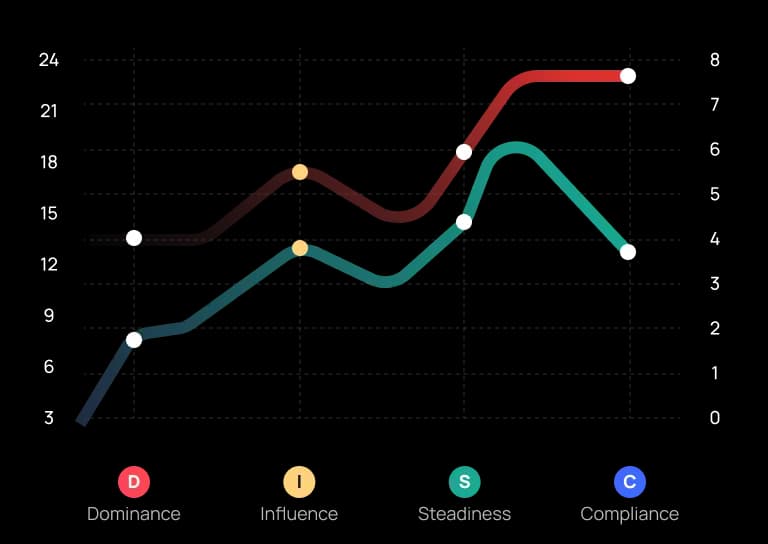
Represents your instinctive behaviors and desires.
Shows the behavioral tendencies you think you should exhibit in specific situations.
Related articles
You may also be interested in
 IQ, EQSep 25, 2026
Why Emotional Intelligence in the Workplace Matters for Leaders
Emotional intelligence in the workplace helps leaders handle difficult conversations, organizational change, employee concerns, collaboration, and conflict.
 IQ, EQSep 22, 2026
Emotional Intelligence and Conflict Resolution: A Practical Guide
Learn how emotional intelligence supports conflict resolution through self-regulation, active listening, empathy, and clear communication.
 IQ, EQSep 22, 2026
What Is a Low IQ Score? Meaning, Ranges, and What It Indicates
Learn what a low IQ score means, where different IQ ranges fall, and why IQ alone cannot determine intelligence, ability, or everyday functioning.
